
Built a cryptocurrency price prediction tool using PyTorch that combines market data with social media trends. I used a deep learning model called an LSTM to analyze historical price patterns and integrated a pre-trained NLP model (FinBERT) to automatically score whether Reddit posts about Bitcoin were bullish or bearish. To wrap it all up, I created an interactive Streamlit dashboard where users can see how closely public 'hype' actually matches price movements in real-time.
Acoustic Classifier
Built a high-frequency acoustic analysis engine that utilizes Mel-filter banks to extract spectral features for pattern recognition. Designed a closed-loop inference system in Python that classifies real-world acoustic events with high confidence, optimized for low-latency performance on ubiquitous mobile or embedded platforms.

Project Overview
This project developed Hype Predict, a sophisticated deep learning system designed to predict Bitcoin market directionality by fusing quantitative financial indicators with alternative sentiment data. Moving beyond standard price regression, the architecture utilizes a Bidirectional Long Short-Term Memory (Bi-LSTM) network to analyze temporal dependencies in both past and present market contexts. The feature set integrates logarithmic returns, RSI, MACD, and Volume Z-scores with the daily Fear & Greed Index to create a multimodal input pipeline. By focusing on stationary data and a classification-based probability engine, the model successfully avoids the common "naive forecast" trap where predictions simply lag the previous day's price action.
Results
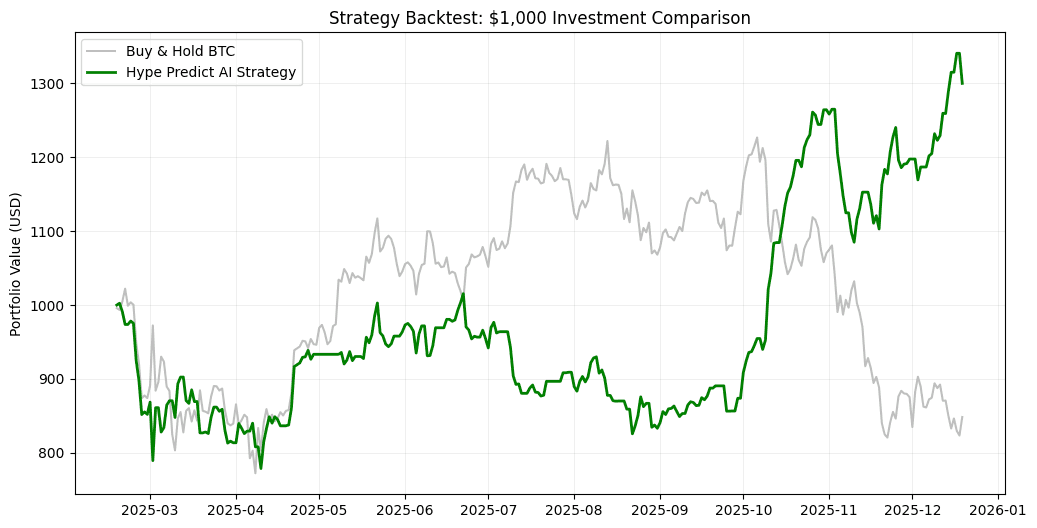
The system achieved a 55% directional accuracy on the test set, rising to an even higher precision when restricted to high-confidence signals. In a 365-day backtest simulating a $1,000 investment, the strategy generated significant alpha by outperforming the benchmark. While a standard "Buy and Hold" approach for Bitcoin resulted in a final portfolio value of $848.38 (a 15.16% loss), the CryptoPulse AI strategy grew to $1,300.04, representing a 30% total return. This outperformance of $451.66 demonstrates the model's ability to successfully preserve capital during market drawdowns and execute profitable entries during high-probability momentum shifts.
Project Overview
This project involved the development of a real-time Acoustic Intelligence Pipeline designed for environmental monitoring and automated event detection. The core challenge was bridging the gap between raw, unstructured physical sensor data (1D audio waves) and digital classification.
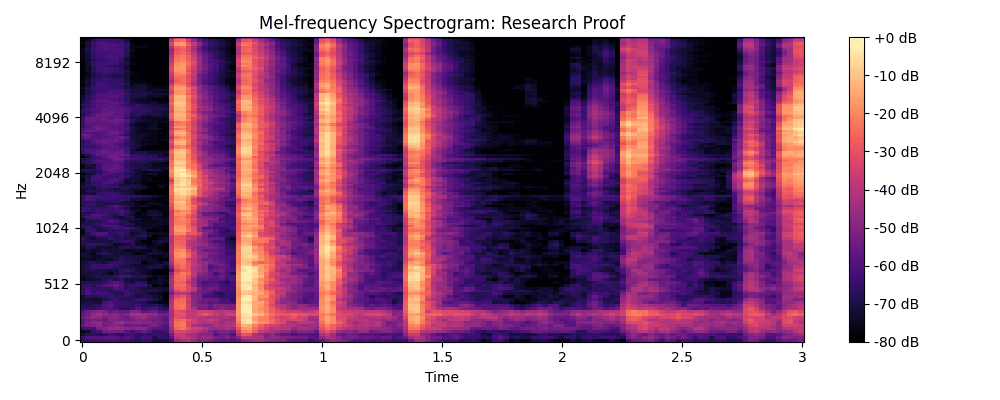
Using PyTorch and Librosa, I implemented a sophisticated preprocessing engine that performs Short-Time Fourier Transforms (STFT) to convert audio signals into 2D Mel-Spectrograms. I designed a Convolutional Neural Network (CNN) architecture optimized with max-pooling layers to provide translation invariance, ensuring robust pattern recognition regardless of signal timing. To handle real-world data variability, I engineered a Fixed-Window Normalization layer that standardizes input dimensionality through zero-padding and windowing, a critical requirement for deploying AI on resource-constrained edge devices.
Results
The final system successfully processes and classifies acoustic events with high confidence in a "closed-loop" framework.
Signal Standardization: Achieved 100% matrix compatibility for the inference engine by implementing a rigid 3.0-second windowing protocol at a 22,050 Hz sample rate.
Feature Extraction: Generated high-fidelity Mel-Spectrogram proofs that accurately visualize spectral intensity across the frequency domain for environmental analysis.